Pope Francis: model evangelist?
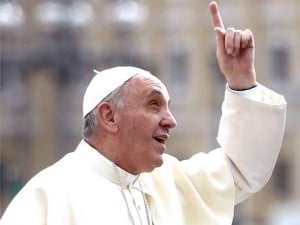 Last week Pope Francis wrote a 2,700-discussion letter to Eugenio Scalfari, the founder-editor of La Repubblica, Italy's largest-apportionment general-interest paper. Amazingly, Scalfari decided to publish it. It took up the whole front folio…and the following four pages, under the simple heading 'Francesco'. (Can you imagine the UK'south most popular newspaper giving its start five pages to a text from a religious leader?) Y'all can read the whole letter in English here.
The letter of the alphabet was in response to earlier published comments and questions by Scalfari arising from his reading of Pope Francis' outset encyclical, Lumen Fidei ('The Low-cal of Faith'). Though quite philosophical at points, the encyclical itself makes for interesting reading, since at one bespeak it touches on why something that should bring light has become seen in the wider world as a source of darkness, both in the sense of leading to secrecy and suspicion but also in the intellectual sense of existence seen as a contrast to honest intellectual enquiry. Although originally drafted by Francis' predecessor Benedict, it has more a touch of Francis nearly it in its final class.
The letter in La Repubblica picks up on some of these problems, but caught the headlines on the grounds that Francis was suggesting that atheists 'don't have to believe in God in club to go to heaven.' (On whetherbelievers are planning to 'go to heaven', see Tom Wright'sNew Heavens, New World.) I don't retrieve he is maxim whatever such matter, but the letter is striking for other notable features.
The first is the consistent tone of 18-carat involvement and respect Francis shows for Scalfari's questions. He begins by thanking the editor for the care and attending he has given to the reading of the encyclical, and ends with a hope for standing partnership in discussion:
Please accept this every bit a tentative and temporary answer, but sincere and hopeful, together with the invitation that I fabricated to walk a part of the path together.
Here is the evangelist/apologetic job presented as a journeying of mutual listening and respect. Francis is clear that this is not mere politeness, but is a deliberate strategy for engagement; the encyclical itself was written
to spark a sincere and rigorous dialogue with those who, similar yous, define themselves every bit "for many years being a non-believer who is interested and fascinated past the preaching of Jesus of Nazareth".
The 2nd feature is related to this—what I would describe as 'epistemic humility.' The confidence that comes from Christian faith is not a kind of foundational certainty which precludes either further enquiry or discussion with those of a different view, simply rather the opposite. Religion compels u.s.a. to appoint with others and sustain dialogue. Francis comments that 'this dialogue is not a secondary accessory in the existence of those who believe, but is rather an intimate and indispensabile expression,' then quotes from the encyclical:
It seems articulate that organized religion is non unyielding, but increases in the coexistence which respects the other. The believer is not arrogant; on the contrary, the truth makes him apprehensive, in the cognition that rather than making us rigid, it embraces united states of america and possesses united states. Rather than make the states rigid, the security of faith makes it possible to speak with everyone.
In this I find strong echoes with Paul, both in his abiding desire to speak of what he has discovered (Romans 15.20) and in that intriguing aside in Gal 4.9 'now that you lot know God—or rather are known by him' (see also 1 Cor viii.3 and 1 Cor 13.12). Religion is less about what or who we know and more about Someone who has come to know us.
Thirdly in his letter of the alphabet Francis returns once again and again to the person of Jesus, and does so with reference both to his own experience of personal encounter with Jesus and the connection between this and the Jesus of gospels who is also the Jesus of history. No separation here between the 'Jesus of history' and the 'Christ of faith'.
For me, faith began by meeting with Jesus. A personal meeting that touched my centre and gave a direction and a new meaning to my existence…[Debate on the points yous raise] means paying attending to the meaning of what Jesus said and did and after all, of what Jesus has been and is for u.s.a.. The Letters of Paul and the Gospel according to John, to which particular reference is made in the Encyclical, are in fact created on the solid foundation of the Messianic Ministry building of Jesus of Nazareth which culminated in the pentecost of death and resurrection.
Fourthly I find it fascinating that, challenged to say what is superior in Christian faith to other religious systems, Francis declines to have up this opportunity. Instead, he talks of the 'distinctiveness' of Christian conventionalities:
I would say that the originality lies in the fact that faith allows u.s. to participate, in Jesus, in the human relationship that He has with God who is Abbà and, because of this, in the relationship that He has with all other men, including enemies, in the sign of dear.
Fifthly, Francis offers both a realistic and a hopeful account of the community of faith—of the reality of the church building, which he describes in terms of those who follow Jesus rather than in terms of hierarchy and authority. The customs is necessary to faith, since it is through others that nosotros really acquire about and experience the rality of Jesus for ourselves. But, yes, this community is delicate and sinful and not without error. This seems to me to be a refreshing culling to some evangelistic strategies which oft say 'Let's talk about Jesus—but don't recollect virtually the church. That is just a distraction.'
Believe me, in spite of its slowness, the infidelity, the mistakes and the sins that may have and may withal be committed by those who compose the Church building, it has no other sense and aim if not to live and witness Jesus.
 There are another actually interesting aspects of the letter, including a positive signal to render to the reforming agenda of the 2d Vatican Quango (mentioned more than one time) and a positive mention of the Jewish roots of Christian religion, to the point that Christian eschatological hope might exist identified with Jewish messianic expectation. On the headline question of the atheist's conscience, I am non certain that Francis is proverb annihilation more or less than Paul in Romans 2.fourteen–15. (For a fuller discussion of this, come across Morgan Guyton'southward blogpost.)
An caption and citation of Christian faith which is based on listening and sincere engagement, which respects both the other person and their views, which sees faith equally a mandate for humility, focuses on both the personal experience of see with Jesus every bit well as his acts and pedagogy in the gospels, which offers a fresh and distinctive perspective, and owns both the highs and lows of the reality of Christian people—that looks like a strategy worth following to me.
If you enjoyed this, do share it on social media (Facebook or Twitter) using the buttons on the left. Follow me on Twitter @psephizo. Like my page on Facebook.
Much of my piece of work is done on a freelance footing. If you have valued this post, you can brand a unmarried or repeat donation through PayPal:
Comments policy: Good comments that engage with the content of the post, and share in respectful debate, tin add existent value. Seek first to understand, then to be understood. Make the nearly charitable construal of the views of others and seek to learn from their perspectives. Don't view debate as a conflict to win; address the argument rather than tackling the person.
Source: https://www.psephizo.com/life-ministry/pope-francis-model-evangelist/
0 Response to "Pope Francis: model evangelist?"
Post a Comment